
The Limits of Current Emotional Intelligence Models
Only a few major models are considered here, but even that is enough to show the difficulty: emotional intelligence is not a single settled construct measured in one standard way. (1–8) Different tools emphasise different abilities, use different methods, and are designed for different purposes. As so often happens in psychology, the existence of many different tools strongly suggests that no single one is yet fully satisfactory.
Compared with IQ testing, emotional intelligence is more heterogeneous. Some measures are self-report questionnaires, some use observer ratings, and some attempt to assess emotional reasoning or performance. As a result, scores across different EI tools are not directly interchangeable.
That does not make such tools useless. Their value often lies less in producing a single definitive score than in highlighting areas for reflection, training and development.
This variability reflects both the different underlying models of emotional intelligence and the different measurement methods used. Someone may score strongly on a self-report profile yet less strongly on a task-based measure, not necessarily because one result is false, but because the tools are assessing different aspects of emotional functioning.
For that reason, the main value of emotional-intelligence frameworks may be developmental rather than classificatory. They are most useful as on-going feedback when they help people understand their strengths, limitations and patterns more clearly over time.
There are other limitations. Emotional functioning is shaped by stress, adversity and circumstance. A person’s emotional capacities may be strengthened in some situations and undermined in others. This makes emotional intelligence more dynamic and more context-sensitive than a simple trait label suggests. Emotional functioning is also very individually shaped. This depends partly on the personal attitude that the person has, either to the situation they find themselves in or to the emotion it may generate. This affects how the person ultimately deals with the situation and the emotion. For example, a person can take an approach that they will take an optimistic view about events or not let bad news bring them down. Another person may decide that, having realised they have got nowhere fast in a given situation, instead of relying on others and being repeatedly let down, they will take responsibility for their own actions and do it themselves.
An emotion is not just a mental event. It is very physical, whether that is through the person’s physiology or a behaviour. It is acknowledged that emotions need to be processed by the brain and therefore also the mind. There is a debate about which comes first. Is it the event which first triggers the appraisal of the event and then the emotional response, or does the event trigger the emotional response first, followed by the appraisal of the event? I suspect both under different circumstances.
A fourth limitation appears when emotional intelligence is detached from a moral framework. Song Guangwen’s short discussion of traditional Chinese personality types, adapted in Figure 3, can be read as an allegory about how people and institutions respond when the surrounding moral climate shifts and former standards are no longer upheld. Rather than fixing this to any one named country, readers may find it more illuminating to think of a country they know well and consider how the people and institutions within it might fit the pattern. (14)
- Top right, ‘square inside and outside’, the person is as you see them. They not only maintain their values but with passion and devotion strive to restore those values under threat.
- Moving to the opposite corner of “round inside and outside”, this person has bent to circumstances and visibly changed their attitude to becoming unsympathetic to others for whatever selfish reason.
- Top left is “square inside and round outside”. This person maintains the inner values but is moving cautiously trying to steer a path that does not highlight their disapproval of the new circumstance.
- Bottom right is the “round inside and square outside”. This person is hypocritical claiming to maintain the old value but in reality, has bent to supporting the new one.
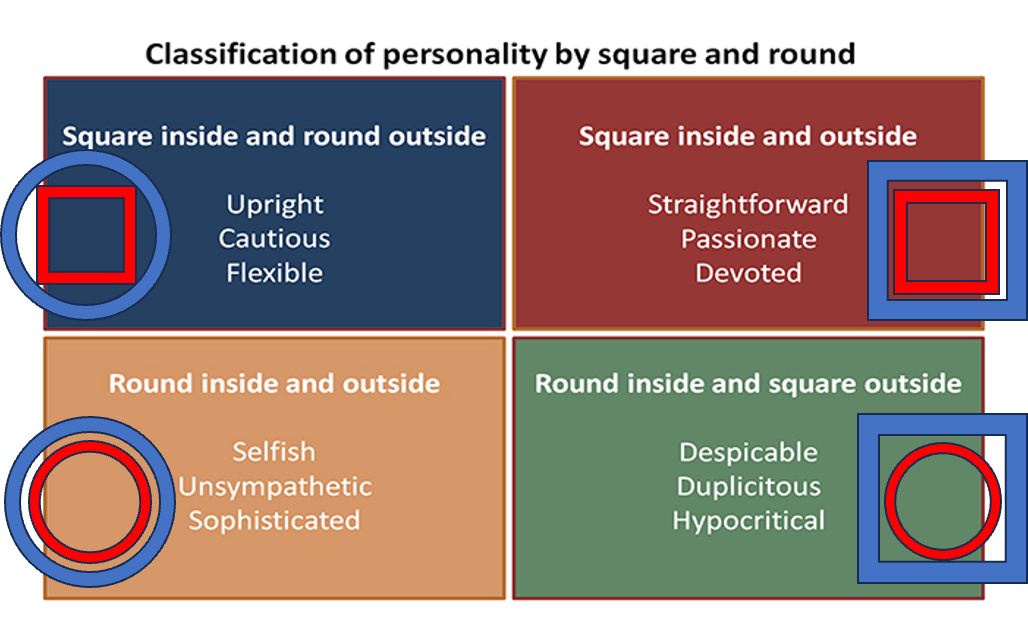
The point of the categorization is not that immoral coping is endorsed, but that emotional adaptation can take more than one form. Some responses preserve inner and outer integrity; others bend visibly to circumstances; others preserve inner conviction while outwardly accommodating pressure; and others display moral conformity without inwardly sustaining it. This matters because a person may appear emotionally effective while still compromising moral standards, reality or responsibility. This is one reason why emotional intelligence on its own is not enough.
This is one reason why emotional wisdom is a more adequate ideal than emotional effectiveness alone. A person or institution can adapt, cope or even appear socially skilled while still moving away from truthfulness, compassion or responsibility. Readers may therefore wish to ask, in relation to a country they know, which public figures and institutions seem to preserve integrity under pressure, which outwardly conform while inwardly shifting, and which appear to sustain democratic standards in both inner commitment and visible conduct. Democratic life depends not only on emotional capacity, but on the moral direction in which that capacity is used.