A Broad Framework of Emotional Skills
Emotional wisdom will come later. First, I want to describe the emotional skills in some detail. As someone who has worked with the emotions of other people and observed how they react, certain patterns and characteristics began to emerge. In studying the subject further, the drawbacks and limitations I described earlier also became clear. Although there was much overlap, there also appeared to be other skills that the experts and researchers had not described. This is not a criticism of them, far from it. The topic is vast and for scientific research to be meaningful it needs to be very precise. It also needs funding and ideally independent funding in which the investor does not have a pre-judged or desirable outcome. This is in contrast to my own observations which could be described as being personal and biased by my own experiences and observations.
There appears to be something very fundamental about the emotional skills and the way they develop within an individual. The more skills a person has, the easier it becomes for them to develop further skills, often in more advanced forms. At the other extreme, where these capacities have for whatever reason become stunted or underdeveloped, the absence of basic tools such as self-awareness, the ability to express oneself safely, or familiarity with relational dynamics may not only inhibit further development but may leave the person unaware that those skills are missing.
I am not aware of any writing anywhere that has attempted to make a comprehensive list of all the emotional skills that are available. In this article that is what I have attempted, while accepting that it is possible that I have still missed some out.
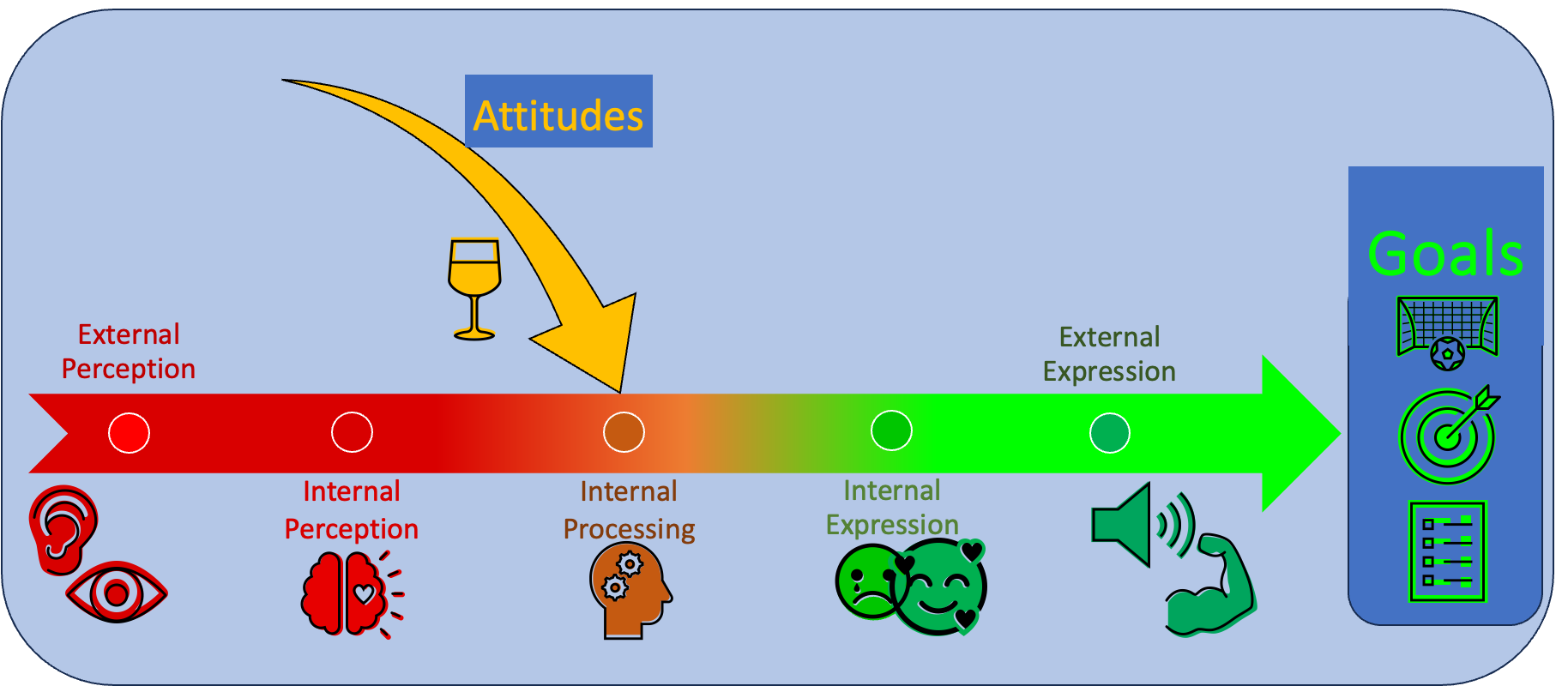
In a democratic spirit, I have taken the attitude that everybody should be believed if they can provide the evidence to make the case and everybody is right based on their own perspective. On this basis I compiled this list of descriptions of what makes or promotes emotional intelligence. Underlying this has been a basic assumption that there is evolutionary benefit to the emotions and that they therefore enhance survivability, first for the individual and then for the species. But then I have also needed to include those very human characteristics in which life has taken on more of a meaning than just survival and reproduction. I have therefore included intrinsic goals and attitudes as part of a person’s emotional framework because these influence how emotions are processed.
The framework is organised into seven categories: goals, internal perceptions, external perceptions, attitudes, internal processing, internal expression and external expression. Figure 4 sketches the overall relationship between these categories. Each category is introduced below with a brief table, while the full master table is retained in the appendix as a reference resource.